Intelligent Systems · Course project P4

Routing vans with learned travel times.

A dispatcher has 20 deliveries with time windows and 3 vans. A neural network learns how long New York trips take at each hour, a CSP decides which van takes which order, and A* finds the best stop order for each van. When a route turns out late, the system learns a new rule and plans again.

View the presentation → All 13 deliverables

3.23 minNN travel-time error (MAE) on a held-out week of 93,592 real trips
30 / 30A* routes identical to brute force (6 to 8 stops)
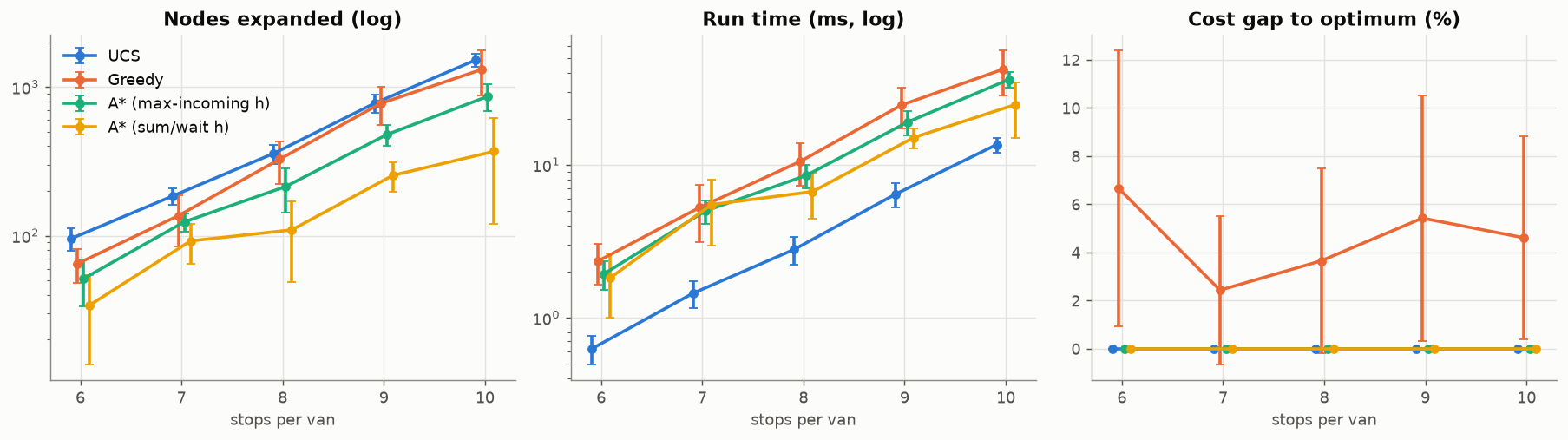
4.1×fewer nodes expanded by A* than UCS at 10 stops
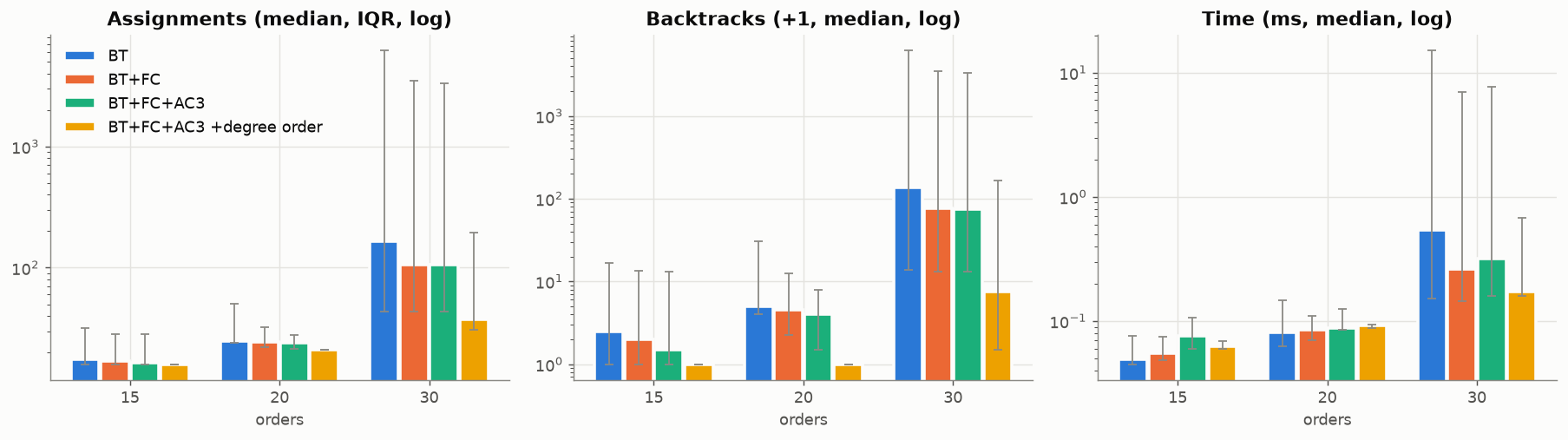
166 → 37median CSP assignments on 30-order instances (BT → FC + AC-3 + ordering)
How it fits together

Three techniques, one loop.

Each part answers one question. The neural network says how long a trip takes; the CSP says which van; the search says in what order.

01 · LEARN

Neural network

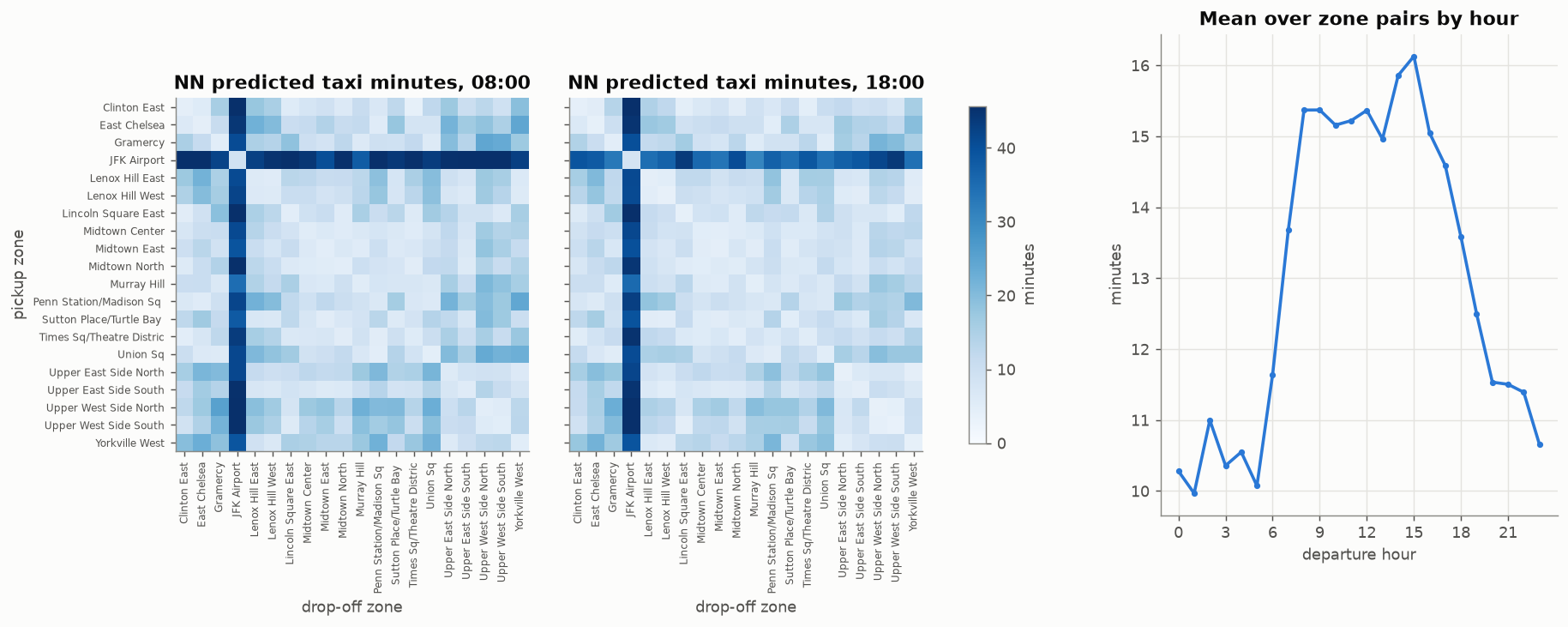
A numpy MLP predicts trip minutes from pickup zone, drop-off zone, hour, weekday and typical distance. Output: a 24 × 20 × 20 hourly time matrix.

→
02 · ASSIGN

Constraint solver

Variable = van per order. Rules: the window is reachable from the depot, capacity, at most 10 stops, and "different van" pairs derived from the NN times. Backtracking, Forward Checking and AC-3 are switchable.

→
03 · ORDER

A* search

State = (stop, visited set, clock). Cost = travel plus waiting. An admissible time-dependent heuristic; UCS and Greedy as baselines.

↺ Feedback: if a van's best route is still late, the first late pair becomes a new "different van" rule and the CSP runs again (up to 5 loops). If nothing works, the system reports which orders are unserviceable and why, and tries widening windows in 15-minute steps.
Data

Real trips, generated orders.

NYC Taxi & Limousine Commission trip records, January 2022. From 2.46 M yellow-taxi trips we keep weekdays, durations of 1 to 120 minutes and the 20 busiest zones (19 in Manhattan plus JFK), about 300 k trips. The split is by day: three weeks to train, the last week to test.

Orders, time windows, demands and van capacities are generated by a seeded generator (15, 20 and 30 orders × 10 seeds). Taxi times only approximate van times, so we apply a documented van factor of 1.2.

StepTrips
Yellow taxi, Jan 20222.46 M
Weekdays, 1–120 min, valid zonesfiltered
Both ends in the top-20 zones≈ 300 k
Test set (last week)93,592
Neural network

Ties the lookup table, wins where data is thin.

A hand-written numpy MLP: zone one-hots (acting as embeddings), hour and weekday encodings and the pair distance, trained with Adam, Huber loss and early stopping. Compared against three baselines on the same held-out week.

ModelMAE (min)RMSEBias
NN (MLP) ours3.235.44−1.87
Historical average (pair, hour)3.245.42−1.61
Distance-linear4.146.40−1.62
Global mean5.458.88−1.31

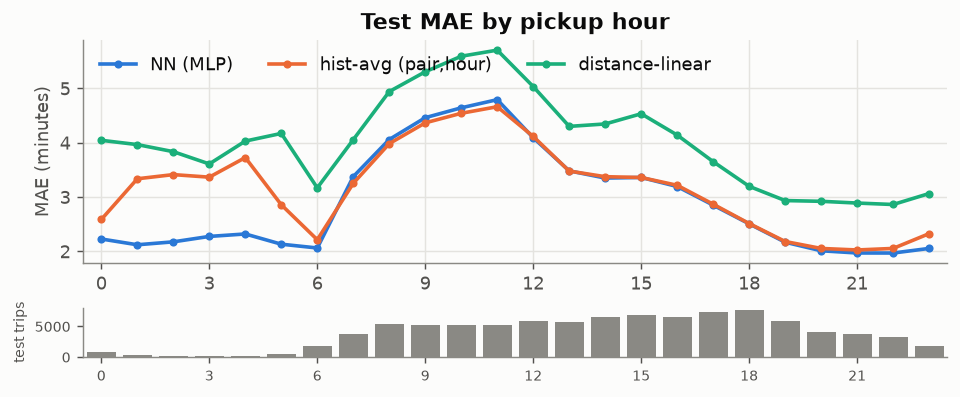
Honest reading: overall the NN is tied with the historical lookup table. Its advantage shows on rare (pair, hour) cells with fewer than 3 training trips: MAE 3.25 vs 4.69. Every model under-predicts the slower test week by about 1.7 minutes.
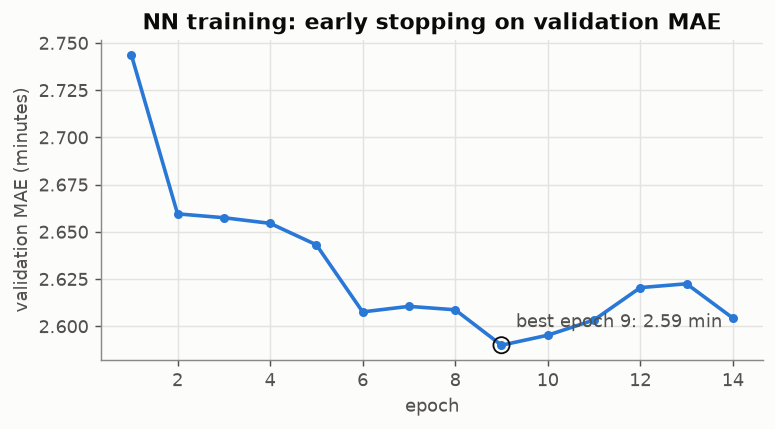
Training and validation loss per epoch
Learning curve with early stopping.
Mean absolute error by hour for each model
Error by hour of day, all models.
Predicted zone-to-zone travel time matrices at different hours
The deliverable the planner uses: the predicted zone-to-zone time matrix, by hour.
Constraint satisfaction

Pruning, switched on and off.

The same hard rush-hour instance (20 orders, windows 09:00 to 12:00, zero spare capacity, 4 rules from the NN), solved four ways. Pick a solver:

Bars show assignments tried. With only 3 values per variable and "≠" constraints AC-3 adds little; forward checking's capacity pruning and most-constrained-first ordering do most of the work.

OrdersSolverMedian assignmentsSolved / unsat / limit
30BT165.58 / 0 / 2
30BT + FC105.58 / 0 / 2
30BT + FC + AC-3104.58 / 1 / 1
30+ most-constrained first36.59 / 1 / 0
CSP assignments and backtracks for 15, 20 and 30 orders
Experiment 2: BT vs FC vs AC-3 for 15, 20, 30 orders.
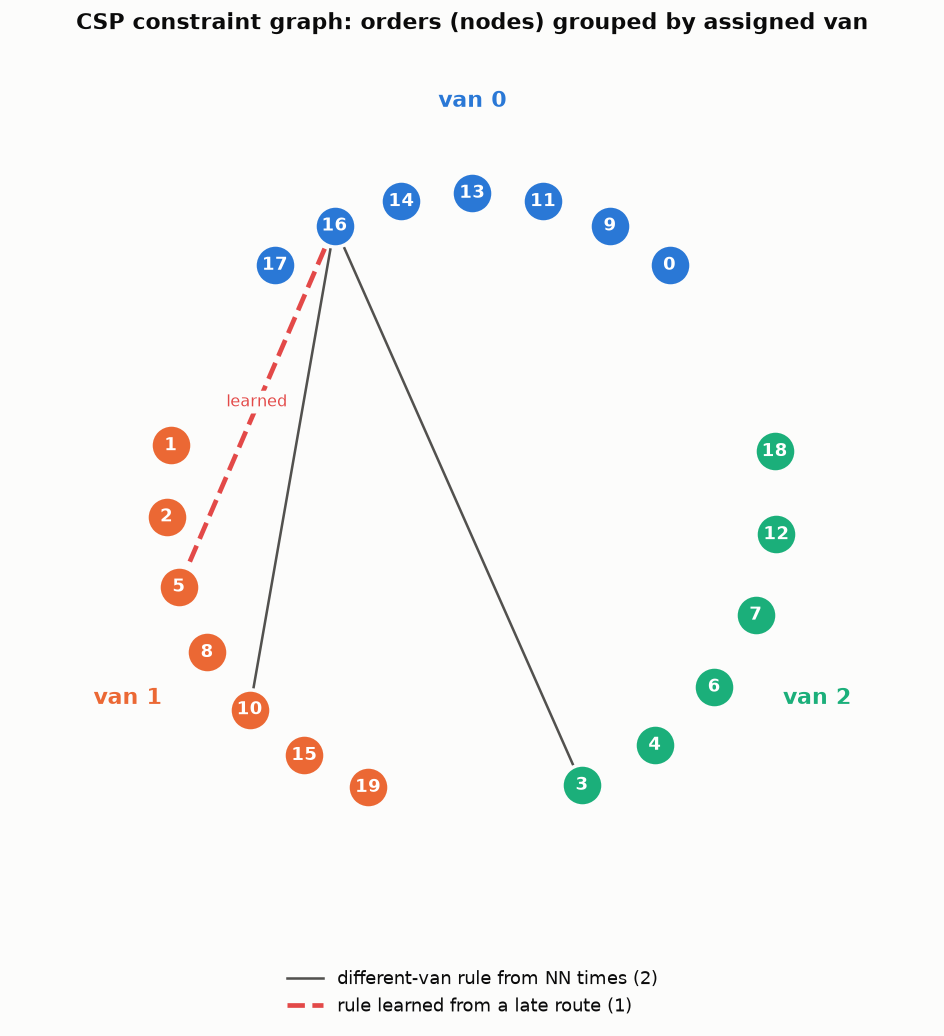
Constraint graph of the demo day with the learned rule dashed
Demo-day constraint graph. The dashed red edge is the rule learned in loop 1.
Demo day · Thursday, 20 orders, 3 vans

Late once, learned, fixed.

=== INTEGRATION LOOP (NN -> CSP -> A*) loop 1: CSP solved (rules: 2 from NN, 0 learned; 20 assignments, 0 backtracks) van 0 late by 2.1 min -> new rule: orders 16 and 5 on different vans loop 2: CSP solved (rules: 2 from NN, 1 learned; 20 assignments, 0 backtracks) status: ok -- all 20 orders on time after 2 loop(s)

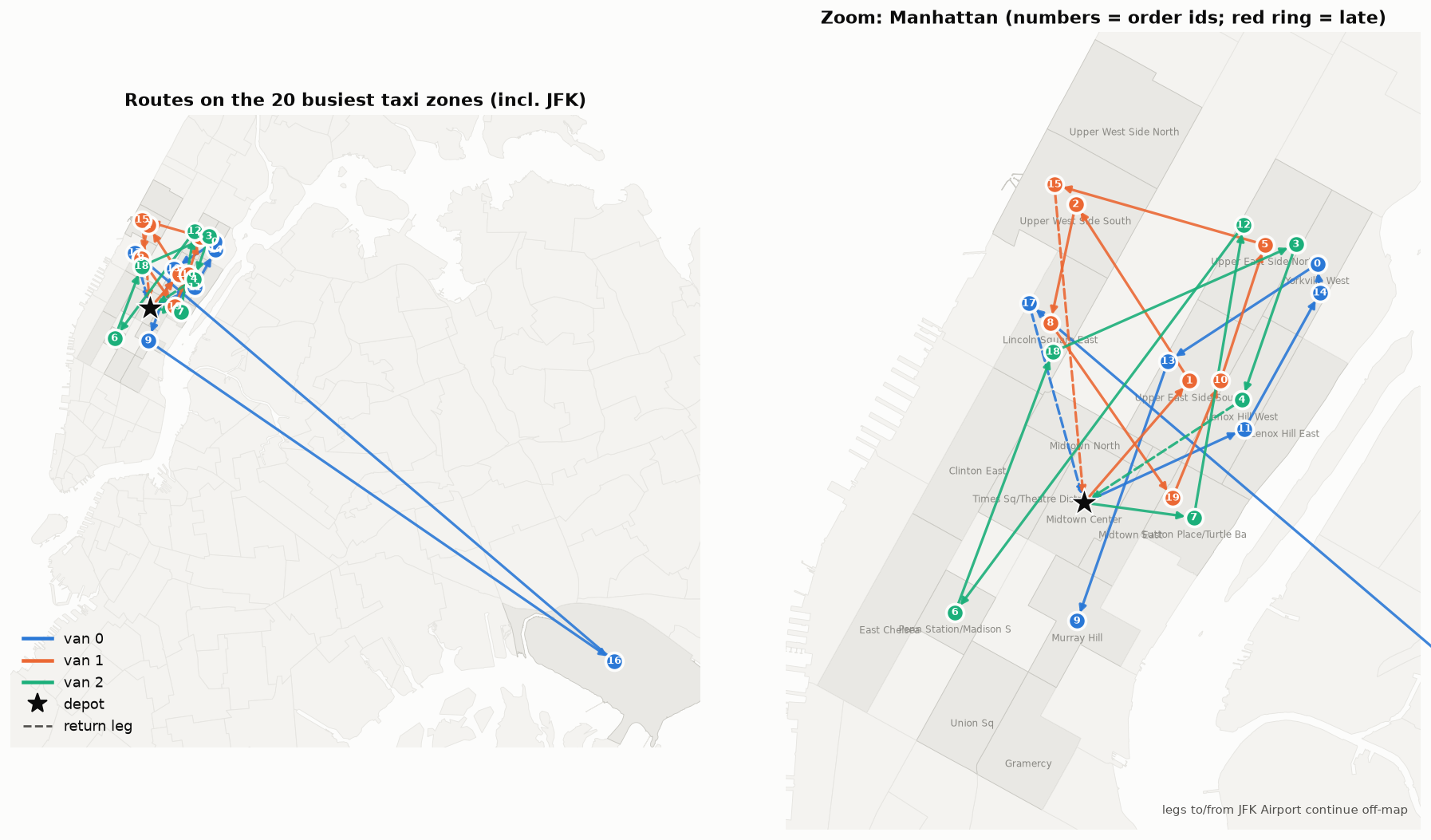
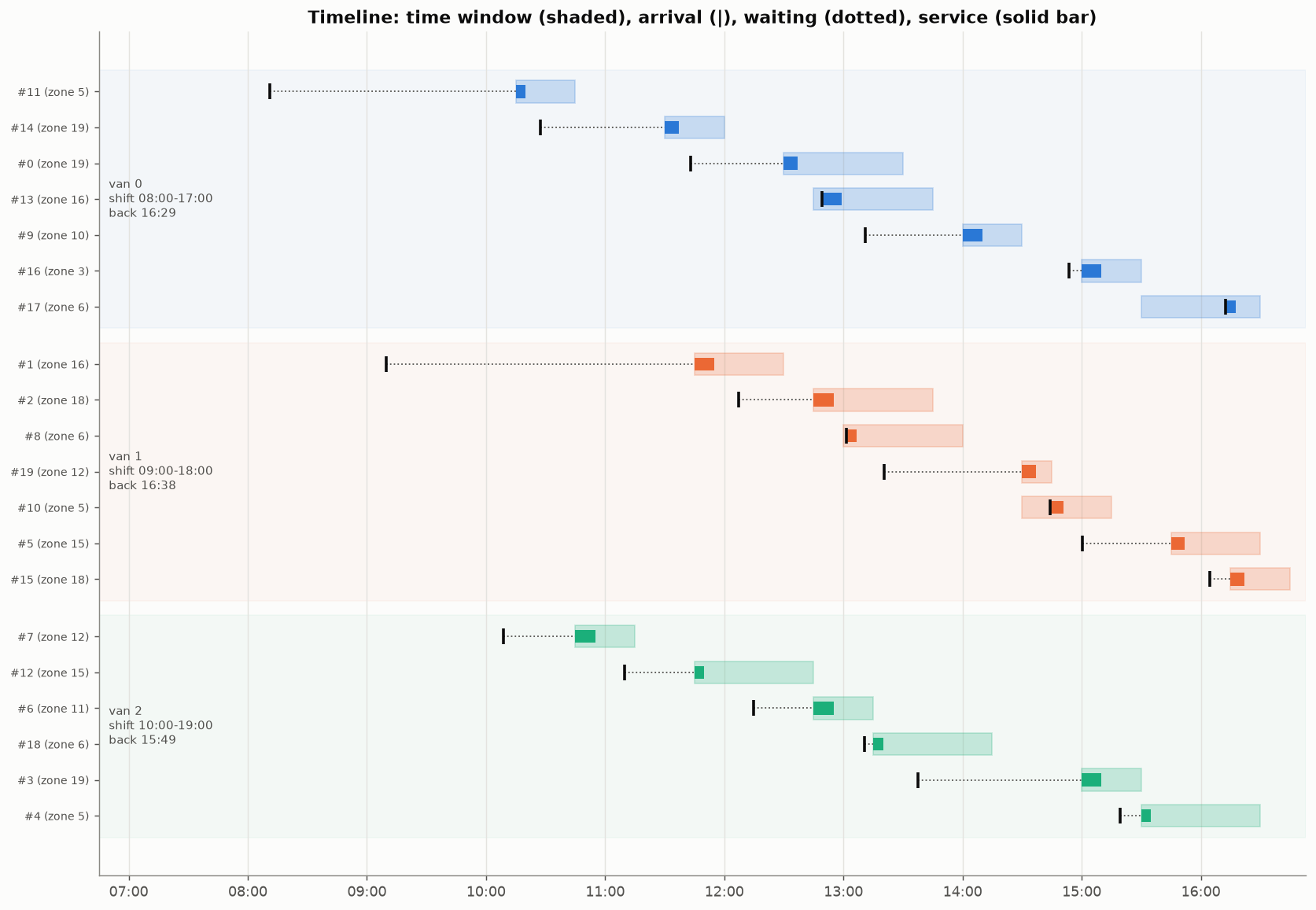
In loop 1, van 0 would serve JFK Airport (15:00–15:30) and then Upper East Side North (window from 15:45): 2.1 minutes late. That pair becomes a rule; in loop 2 every order is on time.

Map of the three van routes across Manhattan and JFK
Routes per van, with a zoom on Manhattan.
Timeline of each van showing time windows, arrivals, waiting and service
Timeline: window, arrival, waiting and service for every stop.

When there is no solution

Run with --impossible: order 0 moves to JFK with a window of 08:00–08:20.

NO SOLUTION: not every order can be served on time. Unserviceable orders / reasons: - order 0: window not reachable from the depot by any van: van 0: earliest arrival 08:48 is after the window closes 08:20 van 1: earliest arrival 09:46 is after the window closes 08:20 van 2: earliest arrival 10:43 is after the window closes 08:20 Suggestion: widening the windows of orders [0] by 30 min (15-min steps) makes it feasible.
Replay simulation

NN on vs off, with real trip times.

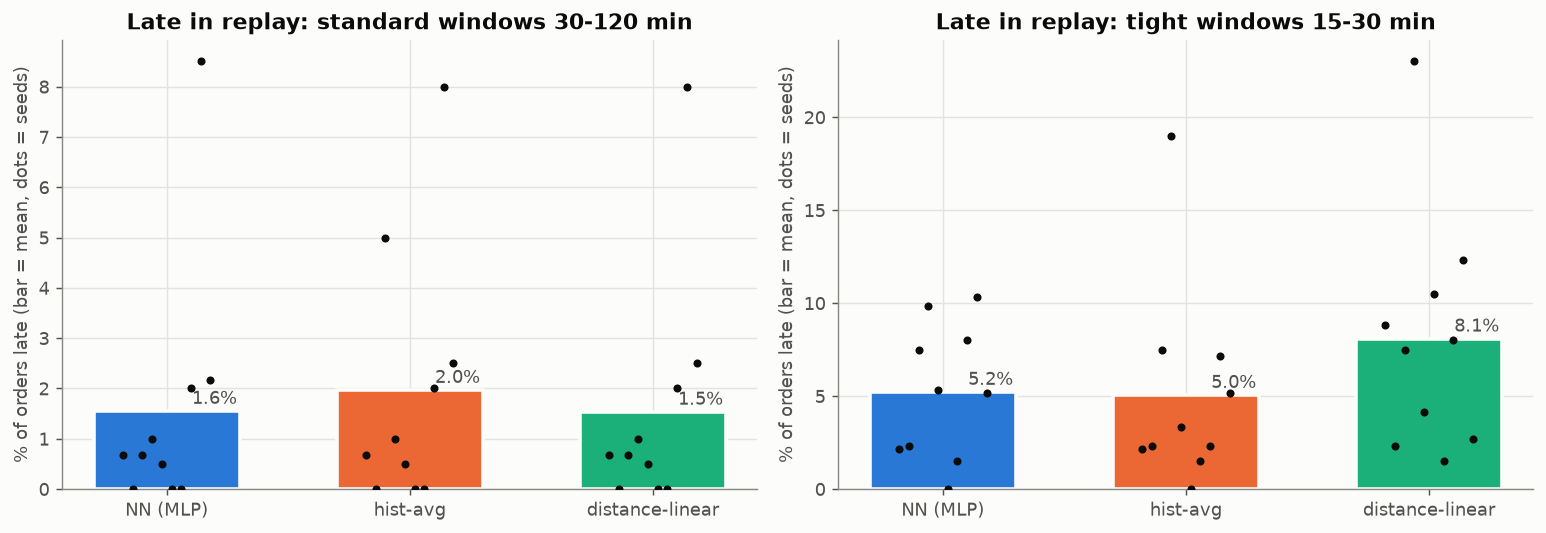
Each plan is replayed with real trip durations drawn from the held-out week, and late deliveries are counted. Experiment 3, 10 seeds per scenario:

With tight windows, hour-aware travel times (NN or historical) are late about 5% of the time versus 8% for distance only. With loose windows all three models are close, so the extra modelling only pays when the schedule is tight.

Late deliveries per model and scenario in the replay
Experiment 3: lateness in the replay.

Limits

Reproduce it

Run it yourself.

Python 3.13, plain numpy (no PyTorch or scikit-learn). All randomness is seeded.

python -m venv .venv .venv\Scripts\activate # Linux/macOS: source .venv/bin/activate pip install -r requirements.txt python make_data.py # download 1 month (38 MB) and preprocess python train_nn.py # ~15 s: train MLP, baselines, time matrices python -m pytest -q # 38 tests: normal, edge and impossible cases python run_demo.py # demo day + outputs/demo_report.html python run_demo.py --impossible # the "NO SOLUTION" case python run_experiments.py # 3 experiments x 10 seeds
Team

Who built it.

M
Moaz Hassan El-Garawany
ID 320240032 · AID S1
A
Ahmed Hossam El-din
ID 320240051 · AID S1